Go Back
How Do Solar Power Plants Work and What Are Their Advantages?
With international agreements, new targets are being set and action plans are being prepared in the fight against climate change. Countries showing sensitivity towards achieving zero emissions are trying to scale up for the transition to renewable energy sources and ultimately eliminate their dependence on fossil fuels. For this reason, the demand for renewable energy sources such as solar energy is increasing day by day.
China ranks first in the list of countries using solar energy the most with 710 GW. The United States ranks second with 200 GW and Germany ranks third with 90 GW. Since the sun is an infinite and low-cost energy source, the increase in solar power plants in the world is a promising development in the fight against climate change. Let's look together at how solar power plants work and what advantages they offer.
How Do Solar Power Plants Work?
Solar power plants are systems that can convert solar radiation, which consists of light, heat, and ultraviolet radiation from the sun, into electricity directly like photovoltaics or indirectly like solar thermal power plants. Apart from these two systems, innovative approaches such as solar towers and solar ponds can also be given as examples of solar power plants. The working principles of solar power plants can be explained as follows:

Thermal Solar Power Plants
Facilities designed to convert solar energy into electricity through a thermodynamic cycle are called solar thermal power plants. In this system where radiation from the sun is used, a thermally conductive fluid is heated and its temperature is raised until it turns into steam.
The generated steam is usually fed through a turbine and an alternator is used to convert the thermal energy into mechanical energy. Ultimately, electricity is produced. When this thermodynamic cycle is completed, the steam returns to its liquid state via a condenser. As this cycle repeats, electricity generation continues.
Solar thermal power plants can be built using linear concentration systems, parabolic trough systems, and solar dishes. The details of these solar thermal power plants are as follows:
Linear Concentrating Systems
In solar thermal power plants using linear concentrating systems, solar tracking mirrors are placed in wide areas. The U-shaped mirrors, namely linear concentrating systems (fresnel reflector systems), are usually aligned in the north-south direction. This ensures maximum capture of solar rays. Linear concentrating systems, which has a high level of mobility due to the receiver tube placed on it, follow the movements of the sun in the east-west direction.
Parabolic Reflectors
Using parabolic-shaped reflectors, these systems can focus 30 to 100 times the levels of sunlight onto the collector. Sunlight is reflected off long parabolic mirrors and focused on receiver tubes that run the length of the mirror. The reflected sunlight heats the continuously flowing fluid inside the tubes. The steam turbine generator then sends water to a heat exchanger to boil it and produce electricity. This allows the systems to tilt according to the angle of the sun and extract maximum energy from the sun.
Dish/Engine Systems
Working with huge dishes with mirror-coated surfaces, solar thermal power plants show similarities with parabolic and linear systems. Solar rays collected by the mirror-coated surface are collected at a thermal receiver located at the central position of the dish to generate heat. This heat, transferred to an engine generator, moves its pistons to generate a mechanical power and allows electricity to be produced through a generator or alternator.
Photovoltaic Solar Power Plants
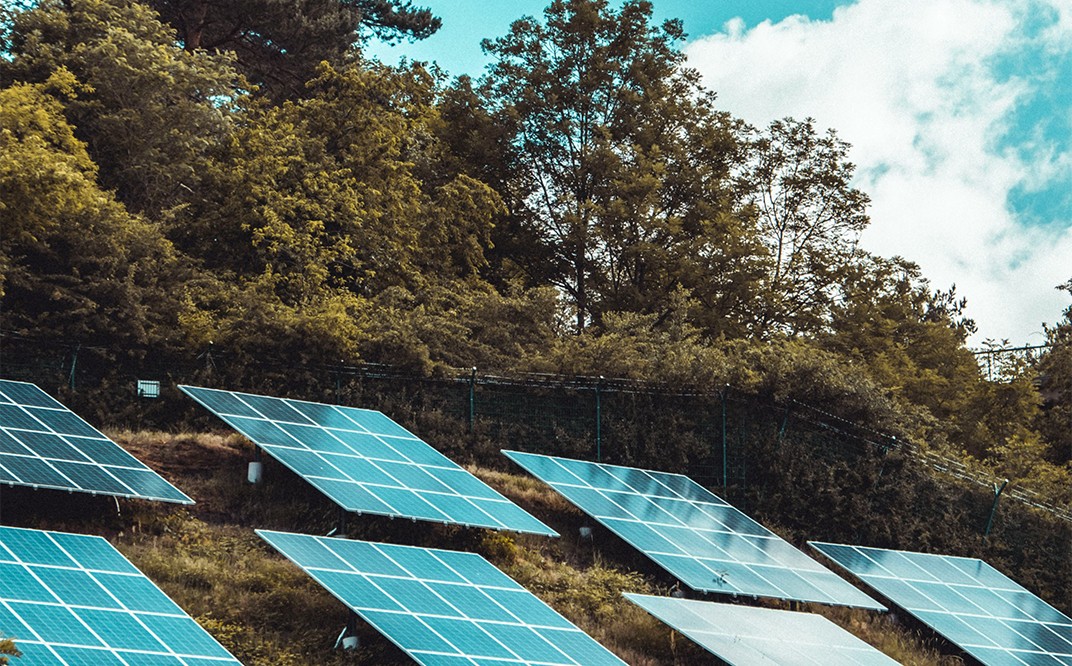
Photons and light energy are the fundamental elements that enable photovoltaic systems to work. Photovoltaic solar power plants differ from thermal power plants where collectors are used because they use solar cells that are photovoltaic or made of silicon.
Electrons in the outer layers of photovoltaic cells absorb radiation from solar rays to generate direct current electricity. To create photovoltaic panels, cells must be connected in series, and for this, they must be integrated into a single module.
Solar panels are connected in parallel, and arrays connected to a current inverter convert the current directed by photovoltaic cells into alternating energy. If the generated electricity needs to use grid lines to be transported to consumption points, the voltage and intensity must be controlled through a transformer.
Photovoltaic solar power plants can be established using crystalline solar panels and thin-film solar panels:
Crystalline solar panels consist of crystalline silicon. There are two different types: monocrystalline and polycrystalline. Although monocrystalline versions perform about 20% better, they are slightly more expensive.
Thin-film solar panels, as the name suggests, consist of light-absorbing films. This panel type is ideal for application on surfaces such as roof tiles. The electricity generated through these panels can be both transferred to grids and stored in batteries.
What Are the Advantages of Solar Power Plants?
Solar energy is much more environmentally friendly compared to energy produced from non-renewable energy sources such as fossil fuels, and is a sustainable energy production model in the long run. Some of the prominent advantages of solar power plants are:
Infinite, Renewable and Sustainable
The fact that most areas of the Earth receive a certain amount of sunlight means that solar energy can be used everywhere. It is a type of energy that can be used in rural areas or urban centers. Individual energy needs can be met with solar panels that can be installed on roofs or balconies, or energy can be delivered to millions of people with solar farms built on huge areas. Moreover, once solar energy is converted into electricity, its distribution is quite easy.
An Energy Source with Increasing Efficiency
The efficiency and overall durability of solar panels and battery storage systems are in a much better state compared to past years. In addition, research conducted so far shows that solar energy has a much smaller carbon footprint compared to fossil fuels.
Although photovoltaic modules and other components of solar panels are made from processed materials extracted through mining activities, the lifetime emissions of solar energy are negligibly small when compared to coal and natural gas.
For example, a coal thermal power plant produces an average of 25 times more emissions than a solar power plant produces. On the other hand, the emission produced by a natural gas power plant is 10 times the amount of emission produced by solar power plants.
Environmentally Friendly and Green Energy
Solar panels are extremely practical not only during the installation phase, but also during the dismantling or replacement process. Materials that can usually be recycled and reused are used in solar panels, which reduces the environmental impact of the panels.
Mini solar panels can be installed for homes, and huge solar power plants for large facilities or living areas. Facilities of different sizes can be built according to local and general needs or specific characteristics. Especially when the extraction process of fossil fuels is considered, waste management of solar power plants is much easier both during the construction process and usage phase.
Reduce Corporate Carbon Footprint with QuickCarbon!
Solar power plants can meet the energy needs of the future as environmentally friendly, renewable, infinite, sustainable, and increasingly accessible energy production systems. Solar panels, which become even more efficient as technology provides new opportunities every day, can reduce the effects of global warming by lowering energy production costs. It does not produce carbon emissions that damage our world and threaten the future of all of us, unlike fossil fuels.
If you also want to determine new strategies to reduce your carbon footprint but do not know where to start, you can use our QuickCarbon software. With QuickCarbon, you can perform calculations and reporting in accordance with the ISO 14064-1:2018 Standard and the GHG Protocol without needing any consultancy services. You can contact us to request a demo in order to make carbon footprint calculations and set sustainability targets based on these calculations.

Get Started Now
Get in touch with us to get to know QuickCarbon better and to see how it can add value to your processes.
Contact Us