Go Back
Carbon Footprint
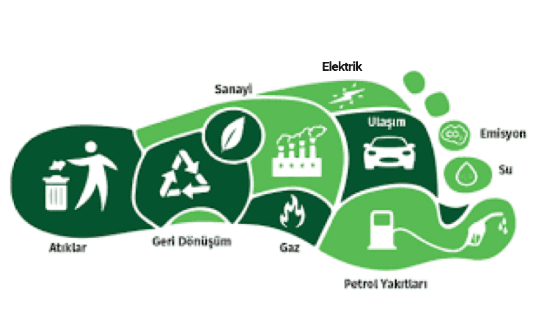
The carbon dioxide equivalent (CO₂-e) of greenhouse gases released into the atmosphere as a result of the activities of an individual, a country, or an organization, such as transportation, heating, electricity consumption, etc., is defined as the Carbon Footprint.
An organization's carbon footprint is calculated in two scopes:
Corporate Carbon Footprint
Product Carbon Footprint
Corporate Carbon Footprint
The measurement of greenhouse gas emissions arising from all activities of companies during the year, such as fuel and electricity consumption, transportation, production, logistics, and service procurement, in terms of carbon dioxide equivalent (CO₂-e) is called Corporate Carbon Footprint.
Corporate Carbon Footprint calculation and reporting studies are based on the GHG Protocol or ISO 14064-1:2018 Standard.
While the GHG Protocol includes Scope 1-2-3 emissions, the ISO 14064-1:2018 Standard requires calculation and reporting within the framework of Category 1-2-3-4-5-6 emissions.
In the GHG Protocol, while organizations calculate Scope 1-2 emissions, including Scope 3 emissions in the calculation is optional, not mandatory.
The ISO 14064-1:2018 Standard, on the other hand, requires calculation based on all categories in an amount that will affect the company's total carbon footprint. If there are categories that the organization cannot include in the calculation, the reasons must be explained in the corporate carbon footprint report.
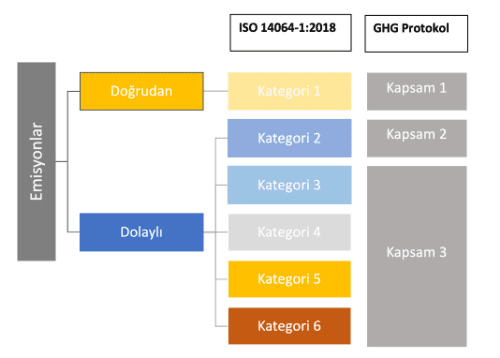
GHG Protocol
Scope 1: Direct Greenhouse Gas Emissions and Removals
Scope 2: Indirect Emissions from Imported Energy
Scope 3: Other Indirect Emissions
ISO 14064-1:2018 Standard
Category 1: Direct Greenhouse Gas Emissions and Removals
Category 2: Indirect Emissions from Imported Energy
Category 3: Indirect Emissions from Transportation
Category 4: Indirect Emissions from Products Used by the Organization
Category 5: Indirect Emissions Associated with the Use of the Organization's Products
Category 6: Indirect Emissions from Other Sources
Product Carbon Footprint
Evaluating the impact of a product or service on the environment throughout its life cycle across all stages from cradle to grave is called Product Carbon Footprint. Product Carbon Footprint calculation is performed based solely on Global Warming Potential (GWP) values among the 6 parameters analyzed within the scope of Life Cycle Assessment.
Product Carbon Footprint calculation and reporting are based on the ISO 14067 Standard. Based on the ISO 14040 and ISO 14044 standards, ISO 14067 focuses strictly on the carbon footprint potential of the product.
Get Started Now
Get in touch with us to get to know QuickCarbon better and to see how it can add value to your processes.
Contact Us